
Teaching Curiosity in a System Built on Answers
Why the future belongs to learners who can explore, adapt, and fail forward—and how education can evolve to meet them there.

Why it matters:
This week I’m heading to South Carolina to spend time with a partner institution continuing a Sprint for their Career Center we kicked off back in August.
During their Fall kickoff, they introduced the team to the Workplace Curiosity Manifesto by Stefaan van Hooydonk and asked if I could explore the concepts and help the team make connections in their “Get Curious” efforts. It quickly made it to the top of my Fall Reading list (share your recommendations) and I was excited to see the ways it aligned with my design language and philosophy.
This post is full of the excerpts that resonated most. It’s not exactly a book review, but hopefully you’ll be motivated to pursue your own curiosity.
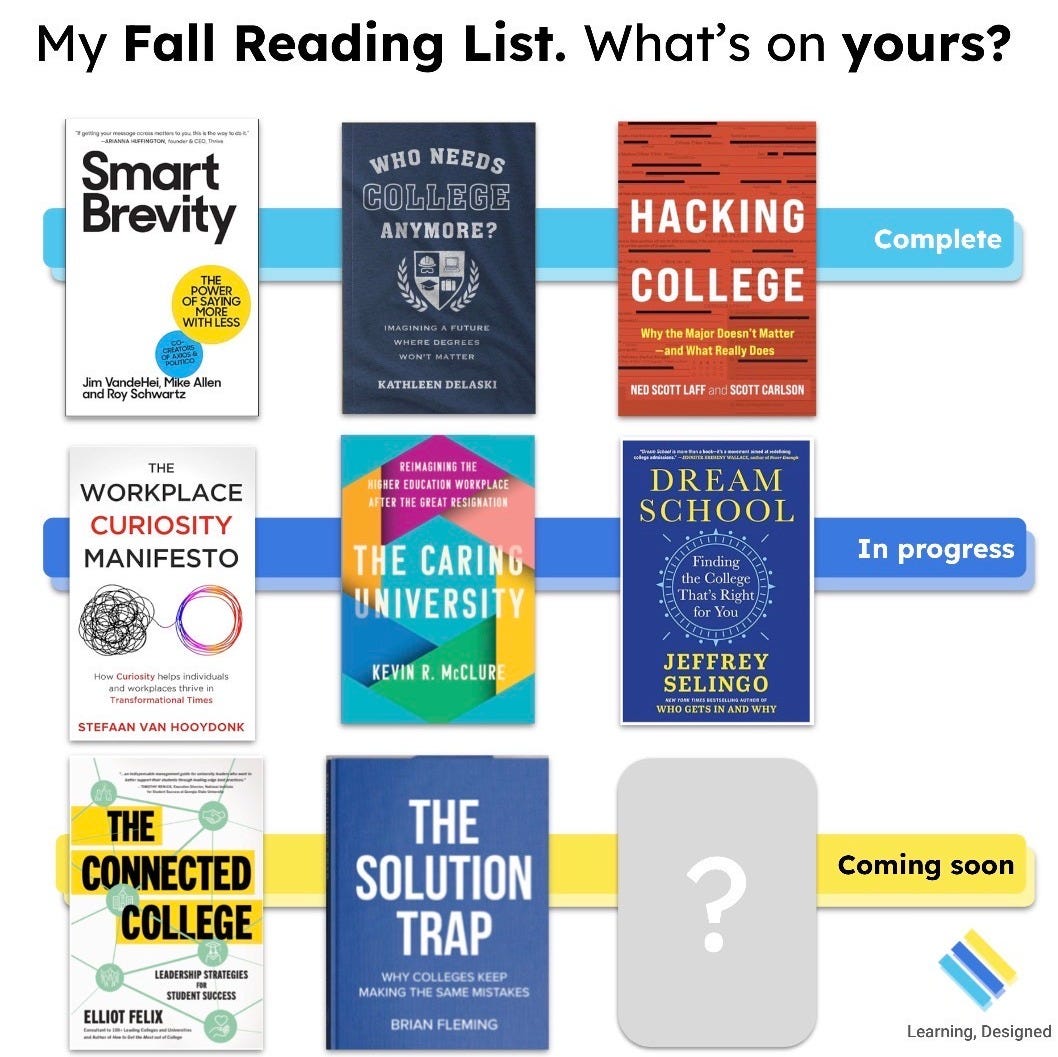
Along with data and insight for my design practice, Workplace Curiosity Manifesto brought color, depth and clarity to so much of what I’ve heard from employers across the country this summer. They’re saying it again and again, mostly with exasperation:
“Being curious is a huge one. I mean, we can train for a lot of skills… but curiosity? I don’t know how to train for curiosity.”
Go deeper:
Curiosity and initiative are emerging in my conversations about early career professionals as “superpowers” that propel new grads to ask questions that unlock insight, to send a pressing, clarifying email, or to test a promising, albeit half-formed, idea.
They’re also the mindsets our education systems seem least equipped to nurture for professionals and students alike.
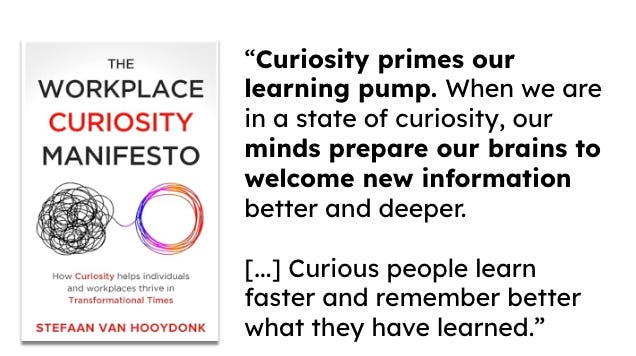
And yet, as Stefaan suggests, curiosity is a critical lever for self-directed learning that drives impact (and concept retention).
The Paradox of Rule-Following Systems
When you reflect on its traditional structures, you quickly see the pattern: most of education is designed around rules. Syllabi. Course sequences. Rubrics. Majors. Students learn to wait for instructions, follow them exactly, and get it “right.”
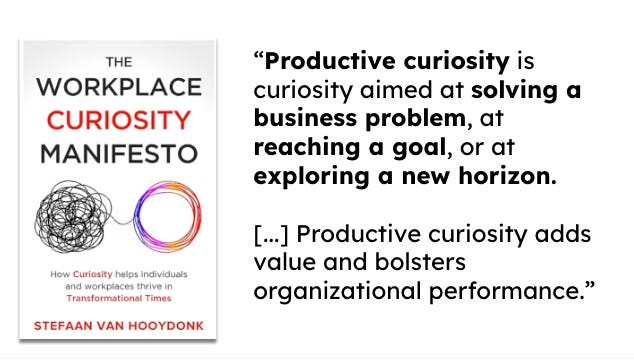
It’s efficient in the production line of education. But curiosity doesn’t live in the world of “right,” it lives in the world of “what if?”
And initiative is proactive curiosity x ownership. It’s the shift from “someone should…” to “I will.” It’s what one employer described when they said:
“Where I see people succeeding is when I see people who are willing to take a chance… to start asking people to meet up with them… to exercise that networking muscle, to take the initiative, to ask, ‘How did you get to where you are?’ and then follow through on those actions.”
That shift is powerful. But for many, it’s terrifying. Especially for those who already feel like outsiders, asking an unexpected question can feel like shining a spotlight on your uncertainty.
And here’s where a hidden ingredient enters: a tolerance for failure.
Curiosity Needs Room to Be Wrong
Every act of curiosity takes courage. It involves risk taking. It’s saying “I don’t know.” It’s admitting “this might not work.” It’s asking “why?” when everyone else nods.
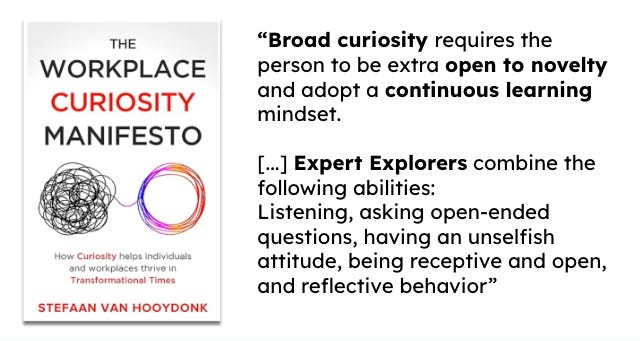
Initiative compounds that risk: it doesn’t just wonder out loud, it acts. It moves from question to experiment knowing the experiment might flop but that the learning is the most valuable asset.
Employers notice when people are willing to do that. One shared:
“Curiosity, adaptability. Those are all really important skills… we always say things are never black and white here. We live in the gray. And complacency is our biggest enemy.”
Curiosity thrives in the gray. But surviving in the gray requires something school rarely rewards: a comfort with ambiguity, with trying something new and not having it land cleanly.
And yet, if we want people who can adapt, we need people who are unafraid to be wrong on the way to being right.
Why Projects, and Design, Change the Equation
This is where project-based work quietly rewires students. When students move from studying known answers to creating new ones, they step into that gray. They have to frame problems, generate ideas, test them, and revise when reality pushes back and feedback shapes fit. They stop asking “what’s the correct answer?” and start asking “what’s possible?”
Projects and their containing requirements make curiosity visible. It gives initiative purpose. And, maybe most importantly, it reframes failure as learning.
In a project, something going wrong isn’t the end of the story. It’s part of the story. It’s the moment that reveals something new, something real.
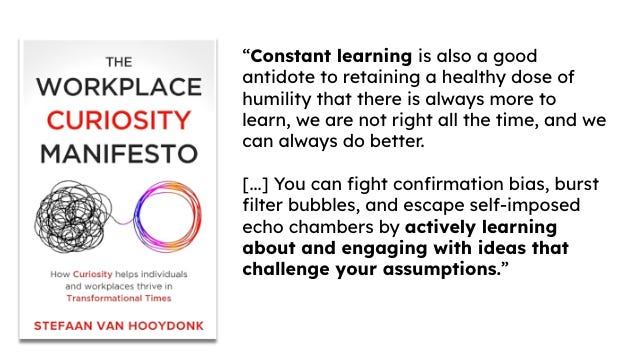
And when students experience the loop of wondering, trying, stumbling, and learning, they start to see failure not as a verdict on their abilities, but as evidence they’re in motion. They learn that curiosity is not fragile. It’s resilient.
The Expertise Trap
Part of what makes this so hard to teach is how deeply our systems reward the opposite mindset, especially for faculty.
Faculty build their credibility, their careers, and their identities around expertise. Their value is measured in answers: reaching the pinnacle acquisition of knowledge and contributing their unique perspective, and ‘professing’ (root: profiteri) their wisdom to others given their doctorate (root: docere). The pursuit of knowledge often becomes a pursuit of certainty.
But curiosity lives on the other side of certainty. It requires loosening your grip on being the expert. It means sitting with questions you can’t immediately resolve. It means modeling exploration when you don’t know where it will lead.
And that’s disorienting in a system where authority and advancement depend on knowing.
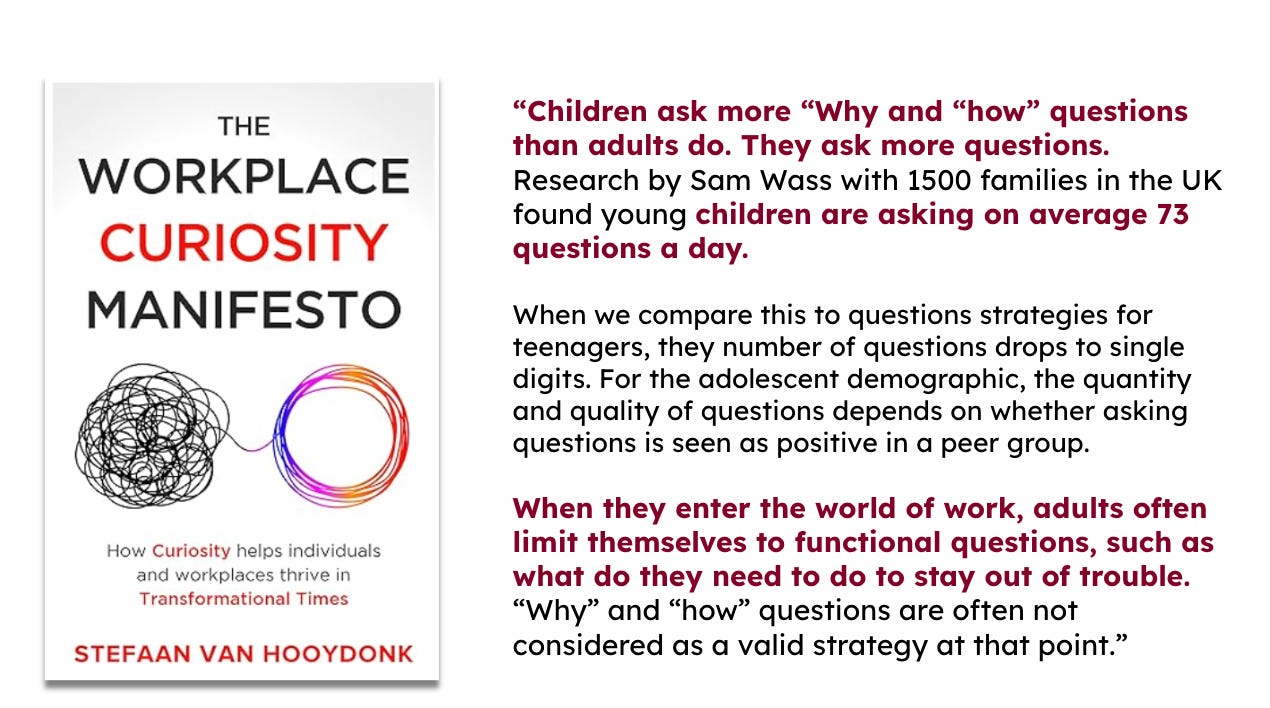
So while students are trying to build the courage to ask questions, they are doing it in an environment where the adults in the room are rewarded for having answers. No wonder curiosity feels risky.
Building Superpowers
Curiosity, initiative, and a tolerance for failure are muscles that strengthen with use. They grow through repetition, reflection, and feedback. And they flourish in environments where risk is not punished but processed; where students are allowed to venture off the map and discover what they can build.
That’s what makes them superpowers: they don’t just help students land jobs. They help them shape the future of the work itself. Because the future doesn’t need more rule-followers.
It needs bold, curious, initiative-takers who can explore uncharted paths, unafraid to fail on the way to finding what works next.
So this week I’m challenging staff to build their own muscles by engaging the challenges their students are facing with navigating their career development: one complex problem, curiosity, possibility, and experiment at a time.
In short, the structure of the design process for problem solving can enable the development of curiosity, the proactive exploration of possibility, and the empowerment of testing, failure, iteration, and resilience.
To learn curiosity and initiative we might just have to unlearn the way we’ve structured the pursuit of wisdom.
Learning and Unlearning
Adam Grant said it best:
“It takes curiosity to learn. It takes courage to unlearn.
Learning requires the humility to admit what you don’t know today. Unlearning requires the integrity to admit that you were wrong yesterday.
Learning is how you evolve. Unlearning is how you keep up as the world evolves.”
Adam Grant, Organizational Psychologist, Wharton School
Nominate or Contribute Insights from the Field
“Insights from the Field” is a regular section sharing quotes from higher ed leaders reacting to the question “What advice would you give to someone driving change in education?”
If someone comes to mind who should contribute, please pass along the short form below (which includes an overview of the format). Feel free to copy me on that referral as well!
👉Share this form with folks you think should contribute their “Insight from the Field.” (or submit your own).
Pilot Durable Skills Resources with America Succeeds
America Succeeds is looking for K–12 educators to pilot lightweight resources focused on durable skills — like critical thinking, leadership, and collaboration. This is a rare chance to influence tools before they’re finalized.
Free, early access, real-world use, and your voice… all part of what comes next!
Curious? Learn more and sign up here: https://americasucceeds.org/k12. Or email Michael Crawford.
Learning is better when it’s social.
If this post moved something in you, tap the ❤️, pass it along, or connect and reach out on Linkedin. I’d love to hear what it sparked!