
Co-Designing with Communities
Building connections, developing trust, and working together towards shared goals

Through my work at UC-San Diego Design Lab and some emerging projects in my consulting practice, I’m spending more time reflecting on my design experiences in communities— where the design requires efforts to both draw in stakeholders because they are not already part of the ecosystem where the design is being proposed, or because the proposed design is new and requires the development of the people who will experience it. However, communities are the key stakeholders that will inform, shape, and offer their experiences, expertise, and feedback.
I’ve gained experience designing in community systems by launching new products, initiatives, or programs in learning and higher education. This approach it requires a skillset of community development and building alongside the human-centered skill sets of building empathy, exploring ideas, and testing and iterating.
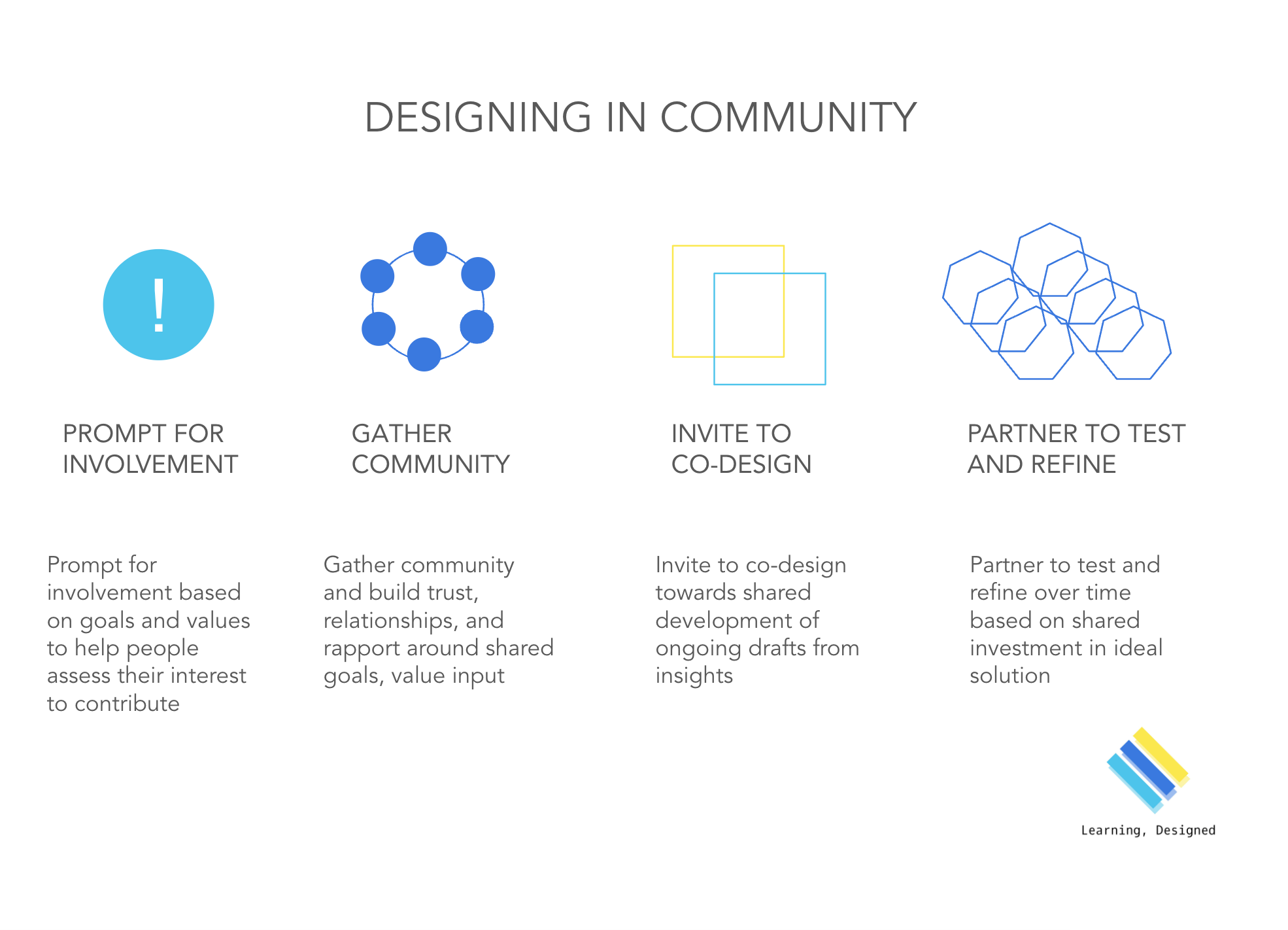
From creating new programs in a community where the University had no presence, to launching learning technologies in a Fortune 500 where it hadn’t changed in 15+ years, to moving a community forward in it’s use of design in education, government, business, and civic organizations, ‘community-driven design’ involves identifying and convening stakeholders to engage, build trust, and show goodwill in a constant effort to integrate their feedback to shape solutions together.
While these activities are not strictly linear, I find they advance as a project progresses to develop new individuals or groups of stakeholders over a cycle of engagement and bring them into the design process. Some activities more naturally map to specific moments in the design process itself, as I will expand on below.
Prompt for involvement
Starts with connecting to build relationships. This is the stake in the ground that invites others into the process by expressing their interest and willingness. It’s an email introduction, an event, a meeting, or a conversation to represent the goals and gauge interest in learning more.
This activity requires engagement of both leaders as well as the people who will directly shape and interact with a newly proposed design over time, and an open-mindedness to consider who might have influence in shaping the design from audiences who may be unexpected.
Consider building a stakeholder map over time through a process of referral, asking “who else should we be talking to?” and let communities themselves inform the stakeholders who might participate and engage.


When building a new Catholic business program from scratch with a community in Tucson, this meant several visits to connect with the Mayor, local business leaders, the local Bishop, as well as community members, guidance counselors, high school leaders and students to help inform whether there was a need in their community, and what shape a design might take for the challenges they were experiencing. All of these stakeholders informed unique perspectives on the needs of the community and project, and built (over time) the needed audiences for ongoing interviews, co-design, and testing in a growing ladder of engagement. It also meant connecting with local community ‘conveners,’ whether meetups, community organizations, chambers of commerce, or simply local influencers who had a pulse on those were best positioned to contribute. This activity might include going on local tours to learn more about community partners, one-on-one meetings and presentations, and slowly building an invite list to a first series of design events.
Important too, this process should surface the larger systems and dynamic environment in which a design must exist, recognizing the goals and criteria it must meet to serve the various players in the ecosystem.
This activity is vitally important as it helps you build local connections that will be a critical part of shaping the design over time by building relationships.
Gather community
With early stakeholders at the table, it takes time to build relationships, trust, and establish shared values and goals for how designers hope to work in the community. This practice means sharing space and power that informs the criteria a solution must meet and what it must do, the challenges it might face and barriers to overcome, and others to bring into the process.
Relationships form over time, and especially when building something new and using a process many are unfamiliar with. This is particularly true when human-centered design is new to a community, as it takes time to establish the approach, practices, mindsets, and goodwill and investment in finding the right answers through community guidance.
Similarly, it’s often true in community development and co-design that there is no “one” defining stakeholder, but many power dynamics and layers of influence who will shape a design over time. Considering what to focus on when, and with what audience, is a key aspect of growing rapport, confidence, and trust over time.


On a single visit to Tucson we often met with groups of business leaders, community leaders, school leaders, the Community College president or provost, as well as high school and college students. These visits would be a mix of meetings to share updates on progress and challenges, to ask for help making local connections based on the highest priority barriers to overcome, and mini design exercises or formal workshops to surface insight as prototypes of the project took shape.
Invite to co-design
With an early foundation established— and perhaps early opportunities to demonstrate what the process of co-design through iteration looked like— we prioritized stakeholders, design goals, and gathered the appropriate stakeholders over time to design, influence, and react as a prototype developed.


By inviting co-design, you build trust based on responsiveness to feedback, and help stakeholders to embrace the ambiguity of a design in process, empowering the community as true partners in its development. As they see feedback take shape based on responsive changes in alignment with needs (and often with explicit notice of where feedback was translated into the design decisions), trust and investment builds as they see their work come to life. The approach to these engagements is to “always bring a prototype,” as every conversation is a chance to talk about the technical and emotional aspects of the design, how it should work, and who might be involved, especially if that stakeholder is key in bringing it to life.
This dynamic is true to inform designs directly through co-creation or to refine existing prototypes through testing and feedback. When people feel heard and represented, they lean into the process, especially when they see that reflected in the result.
It’s here that your time spent with influencing stakeholders and those who will directly interact with the design should be well balanced. While it’s important to hear from leaders in the community and maintain their support and enthusiasm, the approach must be tailored to meet the needs of the people it was designed to support, bringing tests and co-design closer and closer to that source. Over time, this dynamic shifts from influencing a design to testing its effectiveness.
Test as partners to refine
Bringing users to the table to test a design can often awaken peoples’ instincts to ‘sell’ their ideas. A benefit to a community co-designed process is that often they have been part of the process of shaping process and outcomes throughout the process in a way that they have a shared investment in the best product coming out of the process and don’t need to be ‘convinced’ to review or react to it, or to help evaluate a designs effectiveness.


With this, comes the opportunity to bring aspects of the design to life in the real world through small experiments meant to test the assumptions of the design— one by one— ‘de-risking’ the full launch of the program by building confidence that the design was meeting the needs it was designed to address, and in ways that resonated with the people it was designed to support. It was through this activity that we brought curriculum into classrooms of students, program overviews to guidance counselors, events to high schools, and MOUs to the leaders of the community college we worked closely with to deliver the program.
Ready to launch
Over many months of iteration, testing, development, and refinement, the program launched in a hybrid format in the Fall of 2019, getting settled in just in time to navigate the challenges of the pandemic with a full cohort, built for a online-first delivery with in-person supports. Learn more about Catholic University - Tucson here: https://tucson.catholic.edu/
While not a playbook, this is the work and activities of developing connections, building relationships and trust, and working together towards a shared outcome.
These activities are not a replacement for the design process, but helpful guides for operating in community systems to effectively shape a human-centered design.
Do you have a community change or effort that you’re hoping to activate using design? Weigh in in the comments or send me a message, let’s talk about it!
Know someone who is working on community-centered design efforts? Share this post and spread the word.